Enter the Infinite
A exploration of the infinite in Magic.

What is infinity?
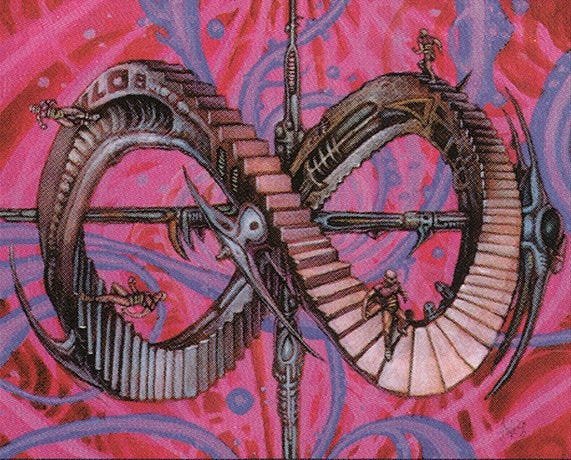
Is it the universe stretching and sprawling into all directions, without a border or edge to hinder it? Is it the spiralling twist of a Möbius strip, like the one referenced on Steve Luke’s Bösium Strip from Weatherlight? Is it the never-ending array of decimals that appear when you attempt to divide ten by three?
The concept of the never-ending is as present in astronomy and mathematics as in religion and literature. As humans we are fascinated by the endlessness of the universe, which clashes with the way we perceive the natural world. Things must end, we proclaim, and yet they don’t. In mathematics, we’re faced with the concept of infinites that are differently sized, a fact that has surely been the source of many headaches throughout history. Still, humans just love the concept of the infinite. We use it to express size and scale, length and distance. It is at the same time unfathomable and a handy figure of size, and we return to it in art, music, literature, movies, in every corner of our cultures.
In Magic, we regularly stand face to face with infinity. We construct intricate Rube Goldberg-machines, stack triggers and targets, and at the end of the contraption we cash in on endless tokens, mana, enters- and/or leaves-the-battlefield triggers. We assemble combos - oh, how we love our combos - and gladly do the same puzzle every game. "I do this one million times” and “Do you agree that I have demonstrated a loop?” are both common phrases at the competitive tournaments and kitchen tables alike. Combo decks that rely on arbitrarily large numbers of repetitions are plenty, from classic Painter’s Servant decks in Legacy to newcomer Bloodchief/Broodscale in Modern. Even Amulet Titan, a mainstay of the Modern meta-game since its inception, has adopted an infinite combo, repeatedly moving Aftermath Analyst and Lotus Fields back and forth between the graveyard and battlefield by way of Shifting Woodlands.
That being said, generating an infinite amount of mana doesn’t win the game by itself. No matter how full our mana pools get (and they can’t ever get truly full), we have to find an outlet, somewhere to spend it. Even the richest man in the world has to pay for what he wants. So we turn to activated abilities and mana sinks, draw our decks with Thrasios and flip cards with Kinnan. We make infinite copies of Primeval Titan by looping Mirrorpool. We make Walking Ballista really, really, really big.
In Magic, true infinity can only exist up until a point. When you assemble the combo of Splinter Twin and Pestermite, you’re technically holding the keys to infinity, but the rules of the game prohibit you from fully unleashing it. Per the rules of the game, whenever you present a loop that you could repeat any number of times and then stop, you’re forced to choose an integer. Whether one million or six billions, a number has to be chosen, it just can’t be infinite. In those cases, infinite loops seem more like shorthand slang; arbitrarily large number of loops just doesn’t have the same mouthfeel. The functional outcome, however, is still the end of the game. Faced with an arbitrary number of hasty faeries or the like, most opponents concede. Similarly, those who assemble Bloodthirsty Conqueror and Marauding Blight-Priest in Foundations Limited are restrained from reaching infinity by their opponents life total. When a player dies, the game ends, and the stack is cleared. Unless our opponent previously set off their own combo to gain “infinite” life, then we’re most likely getting below 25 repetitions, hardly close enough to actual infinity to satisfy the true enjoyer of the endless.
True infinity in Magic results in a draw. The game ends without a victory for either player, with the stack caught in a Groundhog Day-esque temporal loop, unbreaking, forever repeating. Modern card design tries to prevent this, but as always, mistakes happen in large card pools. In the semi-finals of PT Murders at Karlov Manor, Simon Nielsen and fellow dane Christoffer Larsen had their Best of Five bout extended, as Nielsen repeatedly forced a draw, interrupting the combo deck’s loop by casting Loran’s Escape on a Wildgrowth Walker in Game 1, then doing the same targeting Amalia Benavides Aguirre in Game 6. Nielsen eventually took the series in Game 7, securing his spot in the finals against Seth Manfield.
In a way, it feels almost paradoxical. The infinite can exist, but it can’t be controlled. Just like when you were a kid, you can’t count to infinity, but you can make up a really big number. On the other hand, once true infinity has been reached, the game ends on the spot, in the most dissatisfying result it can. Once we set off the perpetual motion machine, it is immediately brought to a halt. Funny how that works.
The infinite loop in Magic fascinates me. There is such an allure to breaking away from the constraints of the game, leaving opponents in the dust with their measly lands and creatures while I fill my mana pool and battlefield. When infinity is too easily reached, it feels unbalanced, an inevitable onslaught that can’t be raced with traditional fair strategies. When it hits the right spot on the power level spectrum, however, the game turns into a beautiful tightrope dance between both players. The game slows down and tapping out becomes synonymous with death. The usual mashing of creatures into the red zone becomes a game of cat and mouse, of who will blink first, two fighters circling each other in the ring. You save your interaction for the right moment, patiently waiting until a guard is lowered, then strike with a precise removal spell on a tapped creature. The threat of the infinite combo rewards the player that knows the meta-game inside out, on both sides of the battlefield. It heightens the tension, and few moments are as exhilarating as when an unsuspecting opponent goes shields down for a turn.
I can’t help but root for those who harness infinity, who assemble contraptions and unleash them onto their opponents, those who generate and create, unrestrained and boundless. Who end the game on the spot, win or lose. Those who balance on a tightrope in mid-air, waiting for the right moment to strike. There is no better feeling than letting infinity loose.
LOVE
AJ
PS. I’ve been pretty busy lately with finals and everything, but I definitely enjoyed thinking about the infinite in Magic. It fascinates me how even the true infinite loops are paradoxically immediately stopped. As usual, thank you for reading! Reach out to me at @AJMTGMAN on Twitter if you have thoughts or just want to talk about infinity in Magic.
Wow, your "tightrope dance" description is spot on. I love games like that. Really enjoyed this piece!