The Elf
A recent encounter with an old friend sparked memories spanning three decades.

I was standing in the dusty backroom of a local game store, lifting white 2000-count boxes from tall shelves and slowly, meticulously making my way through set after set. In a way, it was almost like experiencing Magic in the archives of a museum: neatly organized and labeled, curated in some way. What had originally started as a search for reprints for a Standard brew quickly became an all-out probing of Magic history. After surveying Onslaught, M13, and my personal favorite Return to Ravnica, my eyes fell on a box high up on a shelf, its lid lettered in thick Sharpie. I carefully, almost breathlessly, reached up and pulled out the box labeled Alpha/Beta, gently took the lid off, and started flipping through the cards. No truly expensive finds appeared, save for a beautifully worn Alpha Animate Dead, Anson Maddocks vibrant magenta background contrasting with the thick, rounded, black border. However, as I neared towards the end of the box, a familiar friend showed his face.
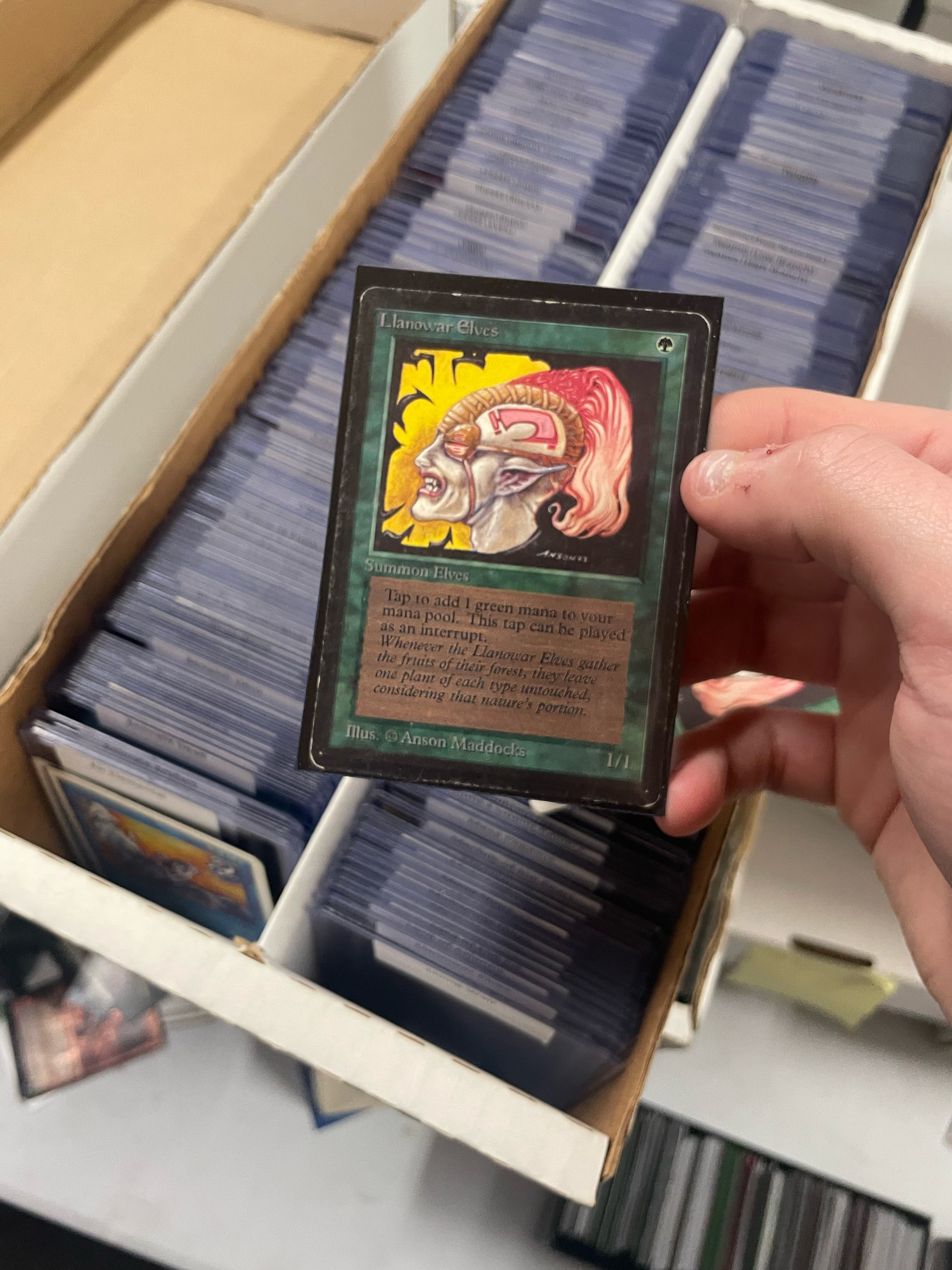
Llanowar Elves is one of Magic’s most reprinted cards. tallying 58 different versions with its recent reappearance in Foundations. It was reprinted a whopping seven times with gold borders, a testament to its success in constructed play. In the box that afternoon, I stumbled upon a Beta elf, its black border beautifully feathered with wear. This card, most recently put into Standard only a mere week before I found it, came out thirty years ago - few cards have had that sort of everlasting glory.
Alpha is full of mistakes. The Power 9 break any sort of attempt at finding a consistent rate of cost-to-power. An embarrassing amount of the cards are stone unplayable, in any form of gameplay. White Ward mechanically does not work as printed. Unsummon has a weird typo - the list goes on and on. But hidden in the messy, uneven, unbalanced card file are a few cards that have survived the test of time. With these cards, WoTC got it just right. Some are more powerful and thus restricted to the higher-power eternal formats, others are welcome anywhere. One of these all around all-stars is Llanowar Elves.
In a set where the designers were still figuring out gameplay, rates, and mechanics, Llanowar Elves (perhaps more than any other card in Alpha) hits the nail on the head. It succinctly explains the mechanics of the game, inherently communicating to the player the conversion between the two primary resources: mana and cards. A player seeing the elf for the first time immediately understands its application, how it translates an investment now into a payoff later - you spend a card and a mana to jump ahead. That is the beauty of the elf - even if you don’t have the words or concepts of card- and mana-advantage, you understand it by just looking at it. Consequently, it inspires deck building as players read the text box and immediately start pondering what card to accelerate into. All of this from a single line of text!
Flavor-wise, Alpha is slightly unfinished, thematically landing somewhere in Dungeons and Dragons-inspired generic high fantasy. There’s little to call unique lore - while the concept of the planeswalker was ever present, the set only covers the plane of Dominaria. Still, through place names and flavor text, it introduces locations, groups, and societies, creating the illusion of a rich and fleshed-out world. Serra Angel does this, as does Llanowar Elves. The game didn’t need a narrative yet, but it did need a universe to exist within, and the first set creates it through those evocative words. When we return to Dominaria in 2018, the iconic elf is there to greet us, alongside cards like the aforementioned Serra Angel, and Juggernaut. Llanowar Elves helped set the tone for the Magic universe from the beginning, and every time it shows up again in booster packs is a reminder of glory days of old. It’s a true icon for the Magic universe, a card that evokes nostalgia no matter what era.
When Foundations was first announced, one of the first cards revealed was once again the elf. As Wizards reintroduced core sets, reshaping traditional Standard legality, and setting the foundation for years to come, some expressed worry about allowing green-based decks to power out three-drops on turn two for five years. Valid complaints considering how the elf has fueled successful constructed decks for close to three decades, all the way back to 1996 in the hands of Bertrand Lestrée at PT New York. Still, what better way to power fair creature decks than the elf? The 1/1 for one green mana has become the symbol of fair, classic Magic, a staple of core sets and green decks across formats throughout the years. As Wizards begin to revitalize the Standard format and Organized Play, few cards are better flag bearers for what the format is about.
Visually, the original Llanowar Elves is a stunning example of the early-90’s fantasy style that exemplified the early sets. It is vibrant, stylized, and striking. Over time, the art of the elf has always represented the era of Magic from which it came. Seventh Edition marked the first departure from Maddocks iconic piece, with Jerry Tiritillis duo. The next update came in 2005 with Ninth Edition. The gritty, detailed style of the Eighth Edition-border era is visible in Kev Walkers homage to the original. Dominaria in 2018 marked the third art, this time by Chris Rahn. The overall art style of the game has shifted a lot over the decades, and the 2018 elf represents the modern era art style perfectly.
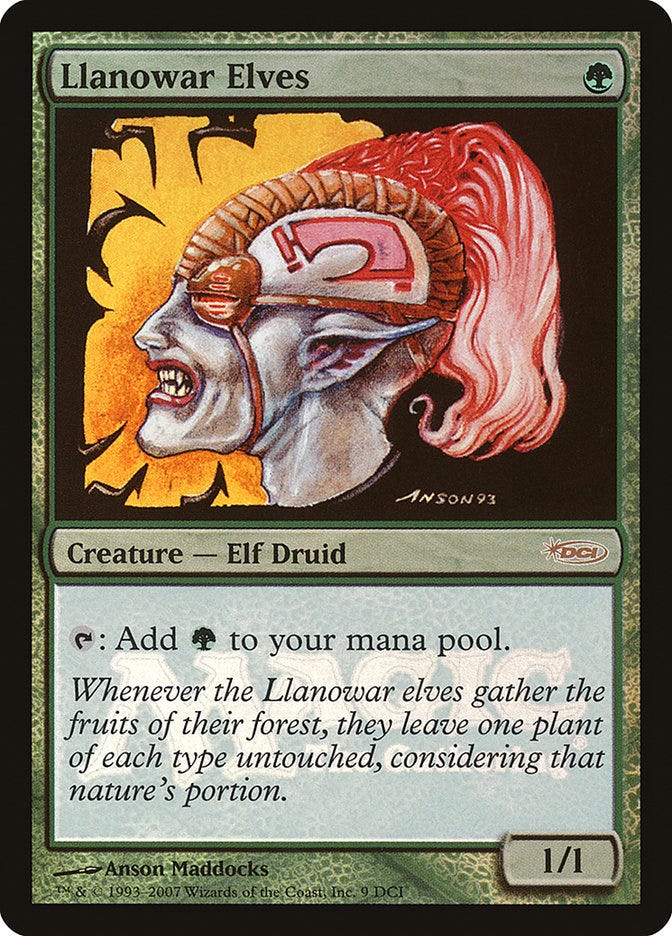
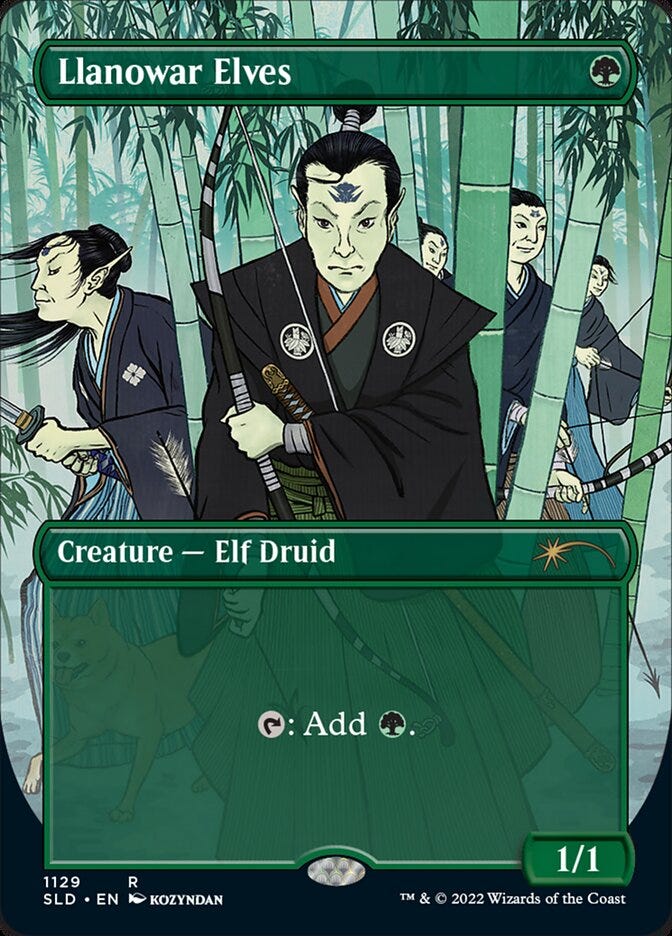
Besides the main set printings, Llanowar Elves has been the subject of multiple promos and special arts. While the first one, a 2007 FNM promo, simply repurposed the iconic Maddocks piece in the new card frame, the Dominaria Open House promo by Victor Adame Minguez went in a different direction. A transparent textbox showcases the vibrant forest framing the perched elf. Four years later, the Secret Lair program reached Llanowar in kozyndans take on Japanese traditional painting. '
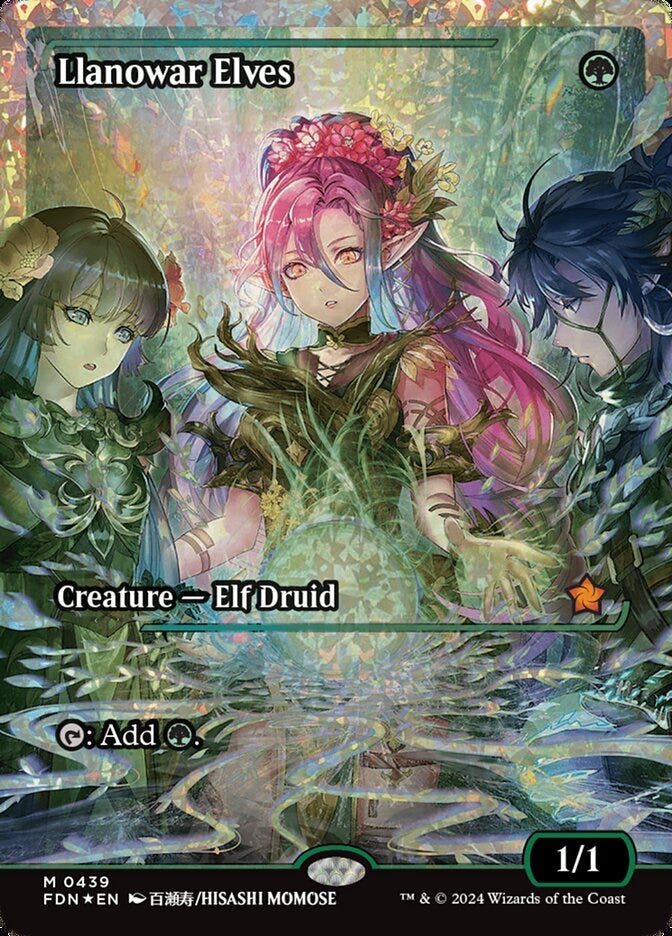
Foundations brought back Kev Walkers homage, printed at common, but it also introduced the most extravagant artwork yet for the card. As part of the Japan Showcase introduced in Duskmourn, the anime-style art by Hisashi Momose resembles a different card game more than anything else. It is representative of the new era of Magic, an era defined by collectability, special foil treatments, and collector boosters. It is almost poetic, seeing a card that has been there from the beginning get to be a part of the new era of modern Magic.
If you ask a Magic player to name the most iconic Magic card, you’ll get a number of different answers. Some will name the Lotus. Others will name Lightning Bolt, Counterspell, jaded veterans Tarmogoyf or Jace the Mindsculptor. Perhaps you’ll hear of Sol Ring, Arcane Signet or Command Tower among those who prefer three opponents to one. If you ask me, I’ll tell you about a creature that has been there since the beginning, a 1/1 that helped define and bring life to the Magic universe. I’ll tell you about a card that exemplifies the resource-based gameplay, a card that inspires deck building and wins tournaments. I’ll tell you about golden borders, about Luis Scott Vargas in Berlin and Raphaël Levy in Lyon. I’ll tell you a card that is ever-present, in drafts and Commander decks, as a promo and a chase rare.
I’ll tell you about Llanowar Elves.
LOVE
AJ
Such an iconic card for an iconic game. <3