The Orzhov Triptych
Analyzing the differences between the three main-set printings of Godless Shrine, and what they tell us about the versions of Ravnica which they represent.

Triptychs appear throughout art history as trifold compositions, often with a cohesive narrative or as portrayals of larger scenes that necessitated division into separate parts. Sometimes the composition of the painting required or benefitted from being divided, with the focal subject flanked by supporting wings. Many altar pieces from the European Middle Ages were triptychs, set in elaborate hinged frames. They stood upright besides the altar, functioning as objects of devotion and aiming to inspire its parishioners.
Ravnica famously draws plenty of inspiration from Medieval Europe, and perhaps nowhere is this more prominent than in the basilicas and spires of the Orzhov Syndicate. The church-slash-business corporation is reminiscent of the Italian houses of the early Renaissance: the Medici, for example, were a wealthy banking family in Florence that had a huge impact on the Florentine society, both economically and culturally. Through their patronage of the arts, religious institutions and wealthy families alike influenced the legacy of Medieval European culture.
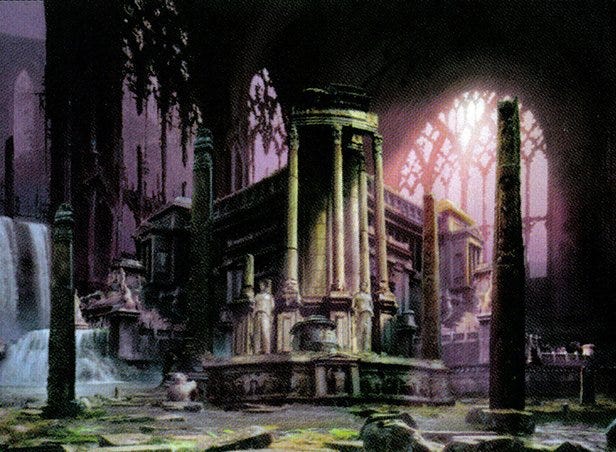
Rob Alexander set the tone for the shrine with the original printing from Guildpact. His signature hazy light shines through a large stained-glass window; deep shadows creep along the space. A towering altar stands central in the composition, but the hall seems decrepit and abandoned. Grass is growing on the floor, rubble lay strewn about. Water streams down the decaying walls. This is a once beautiful, now abandoned space. The light coming through the ornamental window functions as a spotlight, pushing the broken altar into focus. Alexander is telling us about a Ravnica that is lived-in, experienced, rich with history but worn out and forgotten. It is fully leaning into its name: whatever god was once worshipped here has been long forsaken.
When Ravnica debuted in 2005, it was covered in that same grime defacing Alexander’s shrine. As much as it was a bustling cityscape filled with merchants and lawmakers, it was also dark alleys with gruesome monsters lurking in the shadows. Ravnica in its original rendition established certain core tenets that revolutionized how Magic world building could be both an extension of the color pie, and exploratory within the genre, while visually adhering to the grim high-fantasy aesthetic that accompanied the sets of the era. Some argue that Ravnica saved Magic; after the violently powerful Mirrodin block and the weird, uncanny, and underpowered Kamigawa block, Magic was in dire need of a homerun expansion. R&D delivered, cementing the color pairs as philosophical principles of design fundamental to the game moving forward. The ten guilds were visually and mechanically distinctive and recognizable, combining interesting gameplay with unique identities and philosophies. It is perhaps the most important innovation in Magic’s history this side of the millennium.
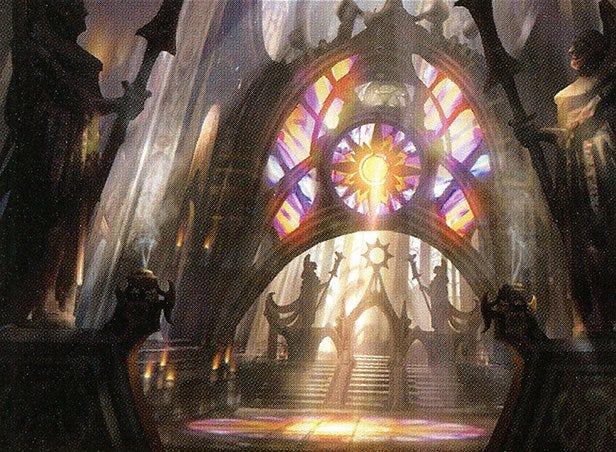
When Magic returned to Ravnica in 2012, Cliff Childs referenced the shadowy and hazy basilica, intensifying the familiar elements. The stained glass is more vibrant, and it takes up the focus of the composition. The sun beams through the central rose window, projecting a prismatic refraction onto the center space. This is Ravnica, and the Orzhov in particular, in reference to itself: the vibrant stained glass, the slight haziness, the arching walls reaching far out of the composition, the dark and looming statues in the foreground all evoke the feeling of the Orzhov like we remember them, religious, ornate, and shrouded. This is not the syndicate exactly like in 2006, but looked back upon with rose-colored glasses. It is the image of an idealized Godless Shrine.
The Return to Ravnica block symbolises Ravnica as an icon, purged of its darkest demons and filthiest grime, remembered for the unique world building and society of guilds. The world is more vibrant and less grimy, more lively, more comedic: compare the arts of Brainspoil and Stab Wound. There’s a noticeable tonal shift away from the gloomy undercity of the original. It is replaced by a much more idealized representation of the ten guilds and the city around them, a city with gridlock and markets alongside monsters and murders. Where the first iteration was an exploration of a cityscape divided along the allied and enemy color pairs, the return is a triumphant return to a fan-favorite setting. It reinforces the distinguishing characteristics of the guilds, promoting players aligning themselves with their preferred one; I am reminded of Brian David-Marshall and Marshall Sutcliffe sporting Simic and Izzet t-shirts respectively, during the PT Return to Ravnica broadcast.
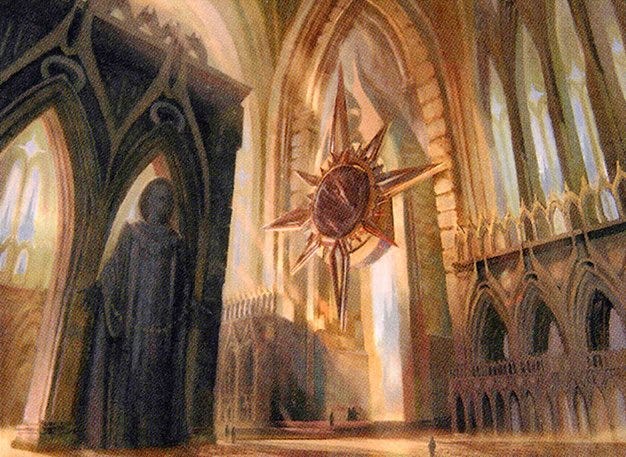
It is Fall in Ravnica when Allegiance arrives in early 2019. Late afternoon sunlight bathes the basilica in Jenn Ravenna Tran’s painting, washing it in amber and gold. A majestic gilded Orzhov sun is suspended in an arch centered in the composition, and a statue stands backlit in an arch in the foreground. Look closely, and you’ll notice the minuscule churchgoers wandering the vast cathedral. The scale of this piece is much grander than in Alexander’s or Child’s. This is the temple of a wealthy Orzhov, of aristocratic dealmakers influencing Ravnica. They know their spaces will be visited, and construct them as such: opulent showcases of wealth and influence. This is the church of a syndicate that knows how it wants to be perceived, that carefully curates its public image. This shrine is a lavish show of power, it’s god long replaced.
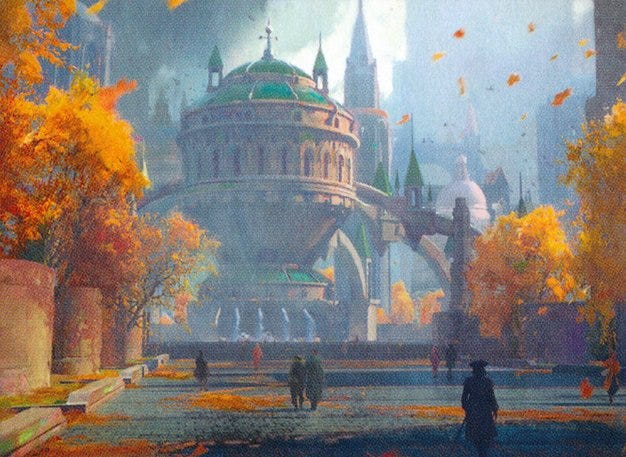
When we return to Ravnica for the third time, the plane has once again shifted tone. Golden beams of afternoon sun slowly give way to a shivering twilight, light rain, and a feeling of unease. Fall has enveloped Ravnica, and the plane is telling a story of anxiety and dread, of days getting shorter and temperatures dropping. Still, the last few rays hasn’t fully disappeared. Trees are still covered in shifting hues of orange. Puddles are forming on the cobblestone streets. The seasons are changing, and we’re shown a Ravnica in transformation. The core traits of the plane have been introduced, they have been refined, and now it is time to see them in a different light, experience them at a time of unease. The plane is continuing the telling of a narrative.
Together, the three artworks portray a guild whose actions takes place both in light and in shadows, a guild of dealmakers and aristocrats, of obedience and of extortion. On their own, the artworks represent three different stages of Ravnican portrayal in Magic. The original sets the tone of the Gothic cityscape: it is dark, gloomy, ornate but worn down. The sequel is brighter, less gloomy, more vibrant. It is Ravnica in a nostalgic shine - it is Ravnica as we, the players, remember it. The last entry in the series is Ravnica in retrospect. It is right before twilight, golden hour sun bathing the cathedral. It is a homecoming, familiar, yet with a longing tone, a returning to old stomping grounds and seeing the change of a space we no longer occupy.
Until next time,
LOVE
AJ
PS: It is probably no surprise that Ravnica is my favorite plane in the Multiverse. The design of the ten guilds, the distinct art styles of the different eras, all come together to tell a story only Magic could tell. For further exploration of Magic’s best plane, please checkout these articles and videos - they’re great.
A Ravnican Retrospective by Rob Bockman
A Ravnican Retrospective, Part 2 by Rob Bockman
The Colors of Ravnica | Painting Magic's Infinite City by Rhystic Studies
The Structures of Ravnica | Building Magic's Infinite City by Rhystic Studies
Awesome read—Trans’ and Childs’ Godless Shrines are so familiar to me that I hadn’t ever processed that they were reiterations. It makes me think about the difficulty of distinguishing between “original” and “derivative” worldbuilding in Magic, since, for so many, what they see as original is already a piece of quasi-revisionist history.